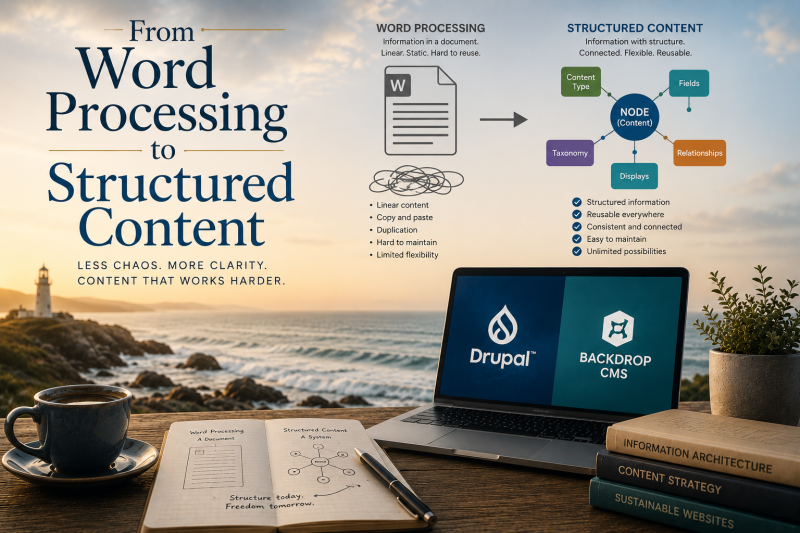
From Word Processing to Structured Content
For many people, a website is imagined as a collection of pages that resemble documents created in a word processor. It is an understandable assumption. After all, if there is a page containing a thousand words, surely someone simply opened an editor, wrote those thousand words from beginning to end, added a few headings and images, and then published the result.
That model has served us well for decades. It is familiar because it mirrors the way we write letters, reports and essays. We think in pages. We compose from the first sentence to the last. When we are satisfied, we save the document.
Drupal invites us to think differently.
Instead of asking us to create a page, Drupal asks us to create a piece of structured content. The distinction may appear subtle, but it changes almost everything about how information is managed.
Suppose we wish to publish an article of around a thousand words. In a word processor, nearly everything exists as one continuous document. The title sits at the top, followed by the body of the text. Images are placed where they seem appropriate. Perhaps there are links or captions, but ultimately the document is a single object. Its meaning comes from the way it appears on the page.
In Drupal, that same article is assembled quite differently.
Rather than opening a blank page, the author is presented with an edit form. Each field on that form represents a specific piece of information. There is a field for the title. Another for the main body. Perhaps another for the summary or introduction. A field for the hero image. Others for categories, publication date, author, related content, featured status or search engine metadata.
As the editor completes the form, they are not constructing a page in the traditional sense. They are populating a structured record. When the form is saved, Drupal instantiates a node containing all of those individual pieces of information.
The page that visitors eventually see is generated from that stored structure.
This separation between content and presentation is one of Drupal's defining strengths.
Because each element has its own field, the information can be reused in many different contexts. The summary might appear on the front page, while the full body appears only on the article itself. The hero image can be automatically displayed in listings. Categories can generate archive pages. The publication date can be sorted, filtered and searched. None of this requires copying or rewriting the content because each piece already exists as structured data.
The benefits become even clearer as a website grows.
Imagine a site containing ten thousand articles. If each one existed merely as a long document, extracting useful information would become increasingly difficult. But when every article has consistently defined fields, Drupal understands the content at a much deeper level. It knows which text is the title, which image is the featured image, which date is the publication date and which taxonomy terms describe the subject.
This is why Drupal websites can produce sophisticated listings, filtered searches, related content, RSS feeds and API responses with comparatively little effort. The information has already been organised during the editing process.
For newcomers, this represents a genuine shift in perspective. The edit form is not simply a more complicated version of a word processor. It is the mechanism by which knowledge is organised before it is presented. The editor is not merely writing a page; they are describing the content in a form that both humans and software can understand.
Word processors are designed to produce documents.
Drupal is designed to manage information.
A web page is only one of the many ways that information can ultimately be presented. Once that change in viewpoint is understood, Drupal's architecture begins to reveal its quiet elegance. The edit form is no longer just a place to type. It is the point at which unstructured ideas become structured knowledge, ready to be presented, searched, reused and transformed in ways that a traditional document could never easily achieve.
Footnote: Although this essay refers to Drupal, the same architectural principles apply almost unchanged to Backdrop CMS. Backdrop originated as a fork of Drupal 7 and retained its core content model, including nodes, content types, fields, taxonomy and much of the underlying philosophy of structured content. Readers familiar with Backdrop can therefore substitute "Backdrop CMS" for "Drupal" throughout this discussion with little change in meaning. While the two projects have evolved independently, their shared architectural foundation remains one of their greatest strengths.